
Bhotekoshi Flood Through My Lens: A Nepal Flood Experience
This is a post I wish we never had to put up. On the morning of August 26th, 2026, a massive collapse of a overhanging glacier and the saturation of the bedrock beneath it sent a fluid wall of rock and ice debris down the Lende Khola and Trishulī Khola rivers, traveling at a estimated 120 mph at times. You have probably seen the videos of the event. At this time around 5,000 people are missing. There is so much to say. This is just beyond devastating.
Our friend and teammate, Roshan Shrestha, traveled to the disaster zone two days after the event. Here is his perspective. We want to share it with you as we feel it is important that this event is documented, that proper care is given to everyone, and that we all plan for a future where events like this may very well become more common.
Roshan was such a big part of our dental camps and climbing competitions when he worked at Wongchhu Peak Promotion. We are so in awe and proud of him for what he has done.
We also want to thank the IFMGA guides who went into the disaster zone looking for survivors. Jen Jen Lama, Dorjee Sherpa, and Ashish Gurung were working diligently at the hydro tunnels. Our friend, Niraj Karki, and our scholarship recipient, Luckme Tamang, were also part of the IFMGA guide response..
So here is Roshan, who gave so much. We thank him and we are honored that he shared his story with us. We send love and prayers to everyone suffering from this horrible event.
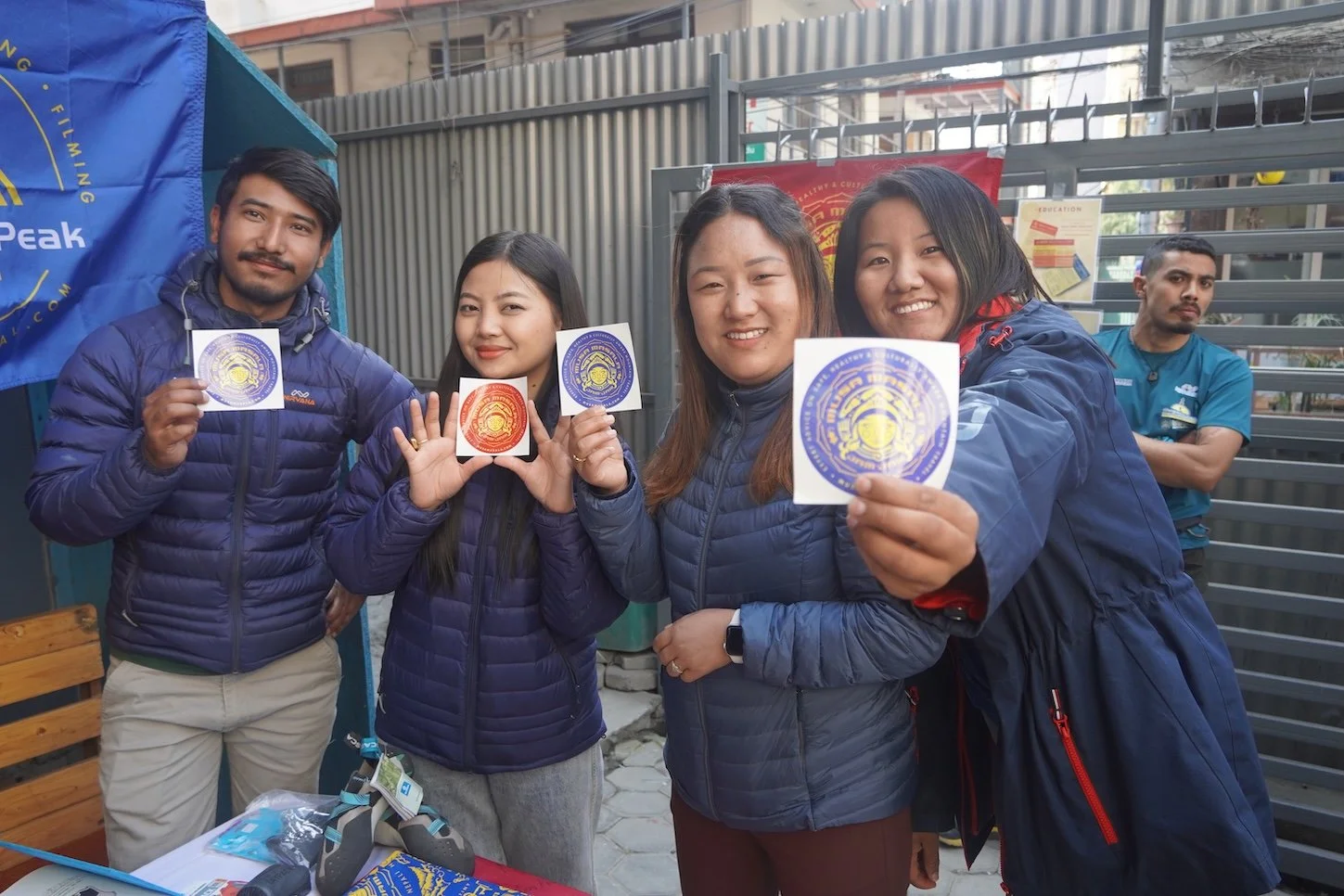
Roshan with Musa
Bhotekoshi Flood Through My Lens
By Roshan Shrestha
August 28, Midnight 11:56 PM
It was past midnight when my phone buzzed. I was half asleep, lost in the quiet of the night, when an Instagram notification suddenly popped up on my screen. I rubbed my eyes and checked the message.
It was Ujjwal.
"Are you ready for Nuwakot?"
My heart skipped a beat. I didn't hesitate. I typed back, "Yes."
Then he told me the plan. Five of us were going; me, Ujjwal, Prithu, Sugam, and Bibek. I could feel a strange mix of excitement and nervousness bubbling inside me.
Me, Ujjwal, and Bibek planned to leave the very next morning. Sugam and Prithu would join us a day later, after finishing their training on PFA (Psychosocial First Aid). None of us knew then that this trip would change us forever.
Meanwhile, our senior team members from Youth Initiative were already on the ground. Yogesh Kafle, our President, and Pawan Gautam, our former President, had reached Nuwakot on August 28. They moved quickly, assessing the damage and talking to survivors. Their hearts ached as they saw the desperation in people's eyes.
After the assessment, they sent us a message that would prove to be a lifeline: "Bring cell phones. People need to hear their loved ones' voices."
They had also taken solar chargers with them, and that small decision turned out to be the most brilliant idea during those dark, devastating days. Because when everything else was gone, all people wanted was to hear a familiar voice on the other end of the line.

August 30, Next afternoon
As planned, I, Ujjwal, and Bibek packed our bags. We collected eight to ten cell phones each one a potential lifeline for someone desperate to hear a familiar voice. Then, with our bags heavy and our hearts even heavier, we got on our bikes and headed to Nuwakot.
The ride was long, nearly three and a half hours. The roads grew rougher, and the air grew thicker. I could feel the silence between us, a quiet understanding that we were riding toward something we couldn't fully prepare for.
When we finally arrived at the Army Barrack in Nuwakot, the first thing that hit me was not a sound, not a sight but a smell.
It was the foul, suffocating smell of death. Dead bodies. The smell lingered in the air like a ghost that refused to leave. My stomach turned. My heart pounded. But I forced myself to keep walking.
Families of the missing were everywhere. Sitting on the cold ground, their eyes hollow, their hope fading with every passing moment. They had been waiting for days, praying for a miracle that might never come.
I sat down next to a survivor. I tried to start a small conversation, just to offer some comfort. But as he spoke, his voice trembled. His lips quivered. And then, without warning, his eyes filled with tears. Big, silent tears that rolled down his dusty cheeks.
He didn't wipe them away.
That moment broke me. It was heart-wrenching in a way I had never experienced before. I wanted to say something, but no words came out. So I just sat there, listening. Sometimes, that's all you can do.
After that, we met Yogesh sir and Pawan sir. We handed over the cell phones we had collected. They looked exhausted but determined. Their eyes told stories of sleepless nights and endless pain.
We also met different officers from RUDEC Nepal, the District Coordination Committee Office, and the NGO Federation. Everyone was working together, trying to bring order to the chaos.
After a short informal meeting, we went for a site visit. We walked to the area where the flood had swallowed everything. But it was almost late evening, and darkness was falling fast. We couldn't see much that day, only shadows of destruction. But even in the dim light, I could feel the weight of what had happened. The silence spoke louder than any words.
We returned to the hotel that night, exhausted in body and soul. We sat together and shared our reflections of the day. The tears, the smell, the hollow eyes, the trembling voices. We talked until our voices faded.
And then, we signed off for the night. But sleep didn't come easily. The images were already burned into our minds.
August 31, 2026
The alarm screamed, tearing me out of a restless sleep. It was already 6 AM. I blinked, trying to remember where I was. Then it all came flooding back. The smell, the tears, the hollow eyes.
We had a quick breakfast, though none of us had much of an appetite. Then we headed toward the site, Dhunge Bazzar.
And that's when I saw it.
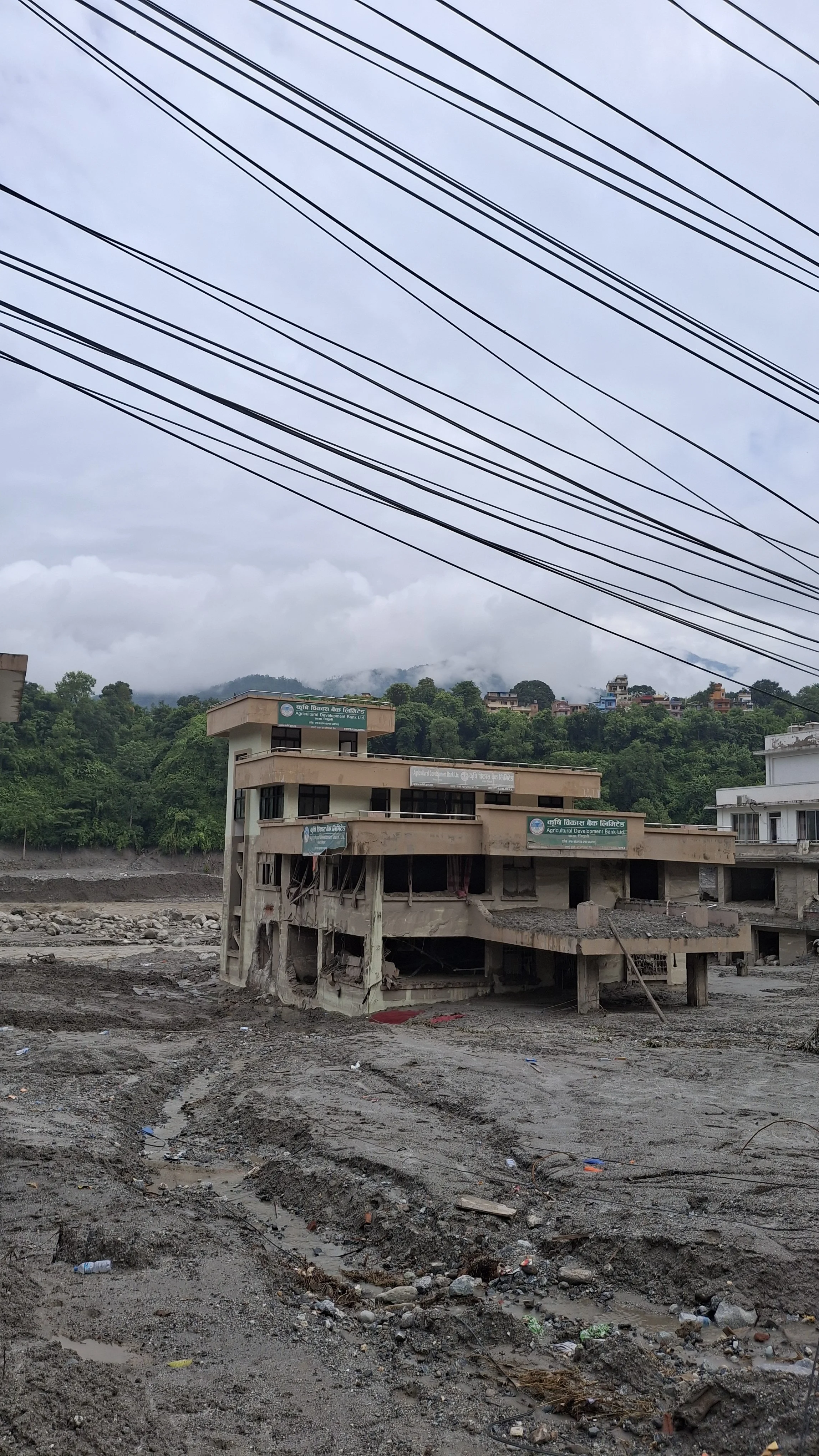
The view was absolutely devastating. Houses that once stood tall and proud were now scattered like broken toys. Many had been swept away completely. Others were buried under mountains of debris, their rooftops barely visible. Four-story buildings that had housed families for generations, they were now underneath the ground. Gone. Just like that.
Starting your day with this view is not something I would wish on anyone.
The environment was pure chaos. The air was thick with sorrow. Media teams swarmed the area, cameras clicking, microphones ready. They were covering the news. But no camera could ever capture what I was feeling inside.
The Communication Desk: A Tiny Island of Hope
After taking it all in, we headed back to the army barrack. We set up our communication desk, a small table with solar chargers and the cell phones we had brought. It looked so simple. So ordinary. But to the flood-affected people, it was a lifeline.
We divided into three teams. Bibek handled the communication desk at the DCC Office. Me and Ujjwal managed the desk at the Army Barrack. And Yogesh sir and Pawan sir coordinated with the officials, making sure everything ran smoothly.
I couldn't believe how many people came to us. They lined up, their hands shaking, their eyes desperate. They just wanted to charge their phones and call their loved ones.
At that moment, I knew we had done the right thing. We had brought cell phones and alternative chargers. Because electricity was cut off. People had no way to connect with their families. No way to know if they were alive or dead.
My heart broke watching them. They dialed numbers with trembling fingers, their faces filled with fear. Some cried when no one answered. Others collapsed in relief when they heard a familiar voice.
I was broken from inside watching them desperately call their loved ones. But at the same time, I felt a strange happiness when I saw their smiles after connecting with someone. That smile, broken, beautiful, full of relief made everything worth it.
Stranded and Waiting
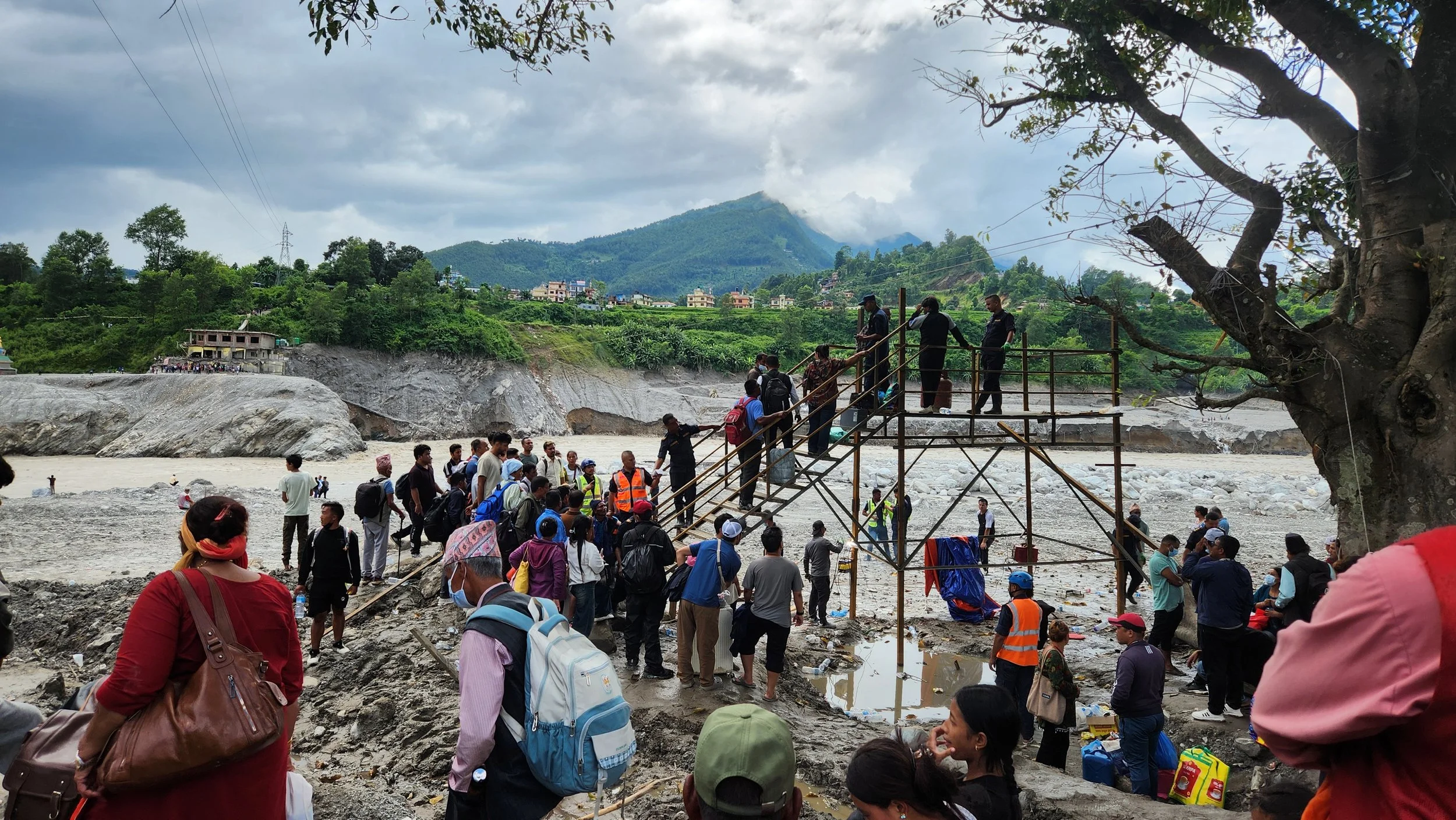
So many people were trying to go home. But the roads were destroyed. The bridges had been swept away. They were stranded on the wrong side of the river, unable to reach their families.
They waited for helicopters to rescue them. I watched as they stood in line, their eyes fixed on the sky. Every time a helicopter landed and someone climbed in, I felt a sense of relief. Every time a helicopter took off with survivors, I whispered in my heart, "Go home. Please go home."
The Smell That Wouldn't Leave
The foul smell was still there. It hung in the air like a dark cloud, refusing to leave. Helicopters buzzed overhead constantly, busy rescuing survivors. Every two minutes, one would fly and land. The sky was crowded. The ground was crowded. The chaos was everywhere.
And then I noticed something. Something that made me worry even more.
There was the terrible smell. The risk of infection was high. But the families and survivors, they weren't wearing face masks. They weren't using hand sanitizer. They had lost so much already. I didn't want them to lose their health, too.
The Evening Horror
And then the evening came.
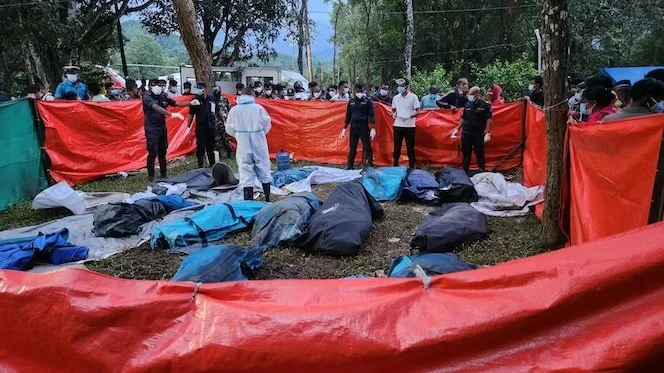
The helicopters brought back dead bodies. One after another. They gathered all the bodies inside the army barrack. Families rushed in, their faces pale, their hearts pounding.
They were trying to identify the bodies. Trying to see if their loved ones were among them.
I watched as people walked past the bodies, their eyes scanning each face. And when they recognized someone, they screamed. They fell to their knees. They cried until they had no tears left.
Many were crying at the sight of the dead bodies. The conditions were terrible. Some bodies were unrecognizable. I saw one woman faint when she saw the face of her husband. She collapsed like a leaf falling from a tree.
We held our hearts strongly. We watched every single dead body, even though it broke us. We had to. Because someone needed to witness what had happened. Someone needed to remember.
Many people fainted there. The shock was too much for them.
Ending the Day
That night, we returned to the hotel. We sat together in silence, our minds full of images we would never forget. We shared our reflections of the day. The chaos, the smiles, the tears, the bodies.
And then we signed off. But sleep didn't come easily. The helicopters kept flying in our dreams.
Sugam Arrives
That evening, our friend Sugam finally joined us.
He had traveled with so much difficulty. The roads were blocked. Landslides had made the journey dangerous. But he didn't give up. He kept pushing forward, facing every hurdle, determined to be with us.
When I saw him walk through the door, I felt a wave of relief. He had made it. He was with us.
But there was sad news too. Prithu's mother had fallen sick, and he couldn't join us. I understood, but I felt his absence deeply.
Our team of five had shrunk into four.
September 1, 2026
The alarm woke the four of us early that morning. We had breakfast in silence. None of us felt like talking. The weight of everything we had seen the day before hung heavy in the air.
Sugam and I went for a site visit while Ujjwal and Bibek stayed behind to set up the communication desk. We walked through the same roads we had walked the day before. But this morning, something was different.
The news hit us like a punch to the chest.
Three dead bodies had just been recovered from the very road we used to walk.
I felt a cold shiver run down my spine. My heart started racing. I turned to Sugam, my voice barely a whisper.
"Did you hear that? Three bodies. From the road we walked on."
Sugam's face went pale. He was shocked too. We stood there for a moment, unable to speak. The road that had been so ordinary just yesterday was now a graveyard. Every step I took felt heavier, knowing that death had been so close.
A Small but Important Step
That morning, we made a decision. We added masks and hand sanitizers to our communication desk. The foul smell was everywhere. The risk of infection was real. We couldn't let people lose their health on top of everything else.
Not only did we provide charging and communication services that day, but we also sensitized people. We told them to wear masks. We encouraged them to use hand sanitizer. It was a small thing, but in a disaster like this, small things can save lives.
We also helped people get evacuated through the helicopters. It felt good to see them leave, to know they were finally going to safety. But it also hurt, because so many were still waiting.
Priyanka - The Girl Who Dodged Death
That day, I had a long conversation with Priyanka, a student of Tribhuvan Trishuli School. She was a flash flood survivor, and her story left me speechless.
She had dodged the flood by just ten seconds.
During the flood, she was in a school bus. The flood was coming from behind, roaring like a hungry beast. She could see it in the mirror, huge, angry, unstoppable.
But the bus driver didn't panic. He showed incredible bravery. He drove fast, kept the children calm, and saved every single one of them. He was a hero. But even heroes couldn't take her home.
Priyanka was stranded on one side of the Trishuli River. Her home was on the other side. She had been stranded for six days. Six long days without her family.
She was waiting for a helicopter to rescue her. But that day, the helicopter didn't come. The sky was too busy, the chaos too overwhelming. So, she walked back to her uncle's home with us, the same place she had been staying since the flash flood.
As we walked together, I looked at her. She was so young. So brave. But I could see the fear hidden behind her eyes. The fear of not knowing what tomorrow would bring.
New Faces Join the Fight
That evening, after we wrapped up the day's work, we returned to the hotel. We sat together and shared our reflections. The images of the day played over and over in my mind. The three bodies, Priyanka's story, the desperate faces of people waiting for helicopters.
But there was also good news. New team members had joined us.
Mandira Shrestha, a nurse and counselor from Kanti Children Hospital. She brought medical knowledge and a gentle heart.
Sujan Danuwar, a civil engineer. He brought technical skills and a calm presence.
Their arrival felt like a ray of light in the darkness.
September 2, 2026
Early that morning, the helicopters were already flying. The sound was everywhere, roaring above us, echoing through the hills, invading our ears.
By now, we were more traumatized by the sound than anything else. The choppers had become a symbol of everything terrible. A rescue, yes, but also death. They brought survivors, but they also brought bodies.
We couldn't escape the noise. It was in our heads. It was in our dreams. Even the ceiling fan above us. Its soft, rhythmic spinning sounded like a helicopter. Every time I heard it, my heart would race. I would freeze for a moment, waiting for something terrible to happen.
That's what trauma does to you. It changes how you hear the world.
The Miracle Crossing
We had breakfast. Then we headed straight to the river.
And that's when I saw it. A miracle happenning before my eyes.
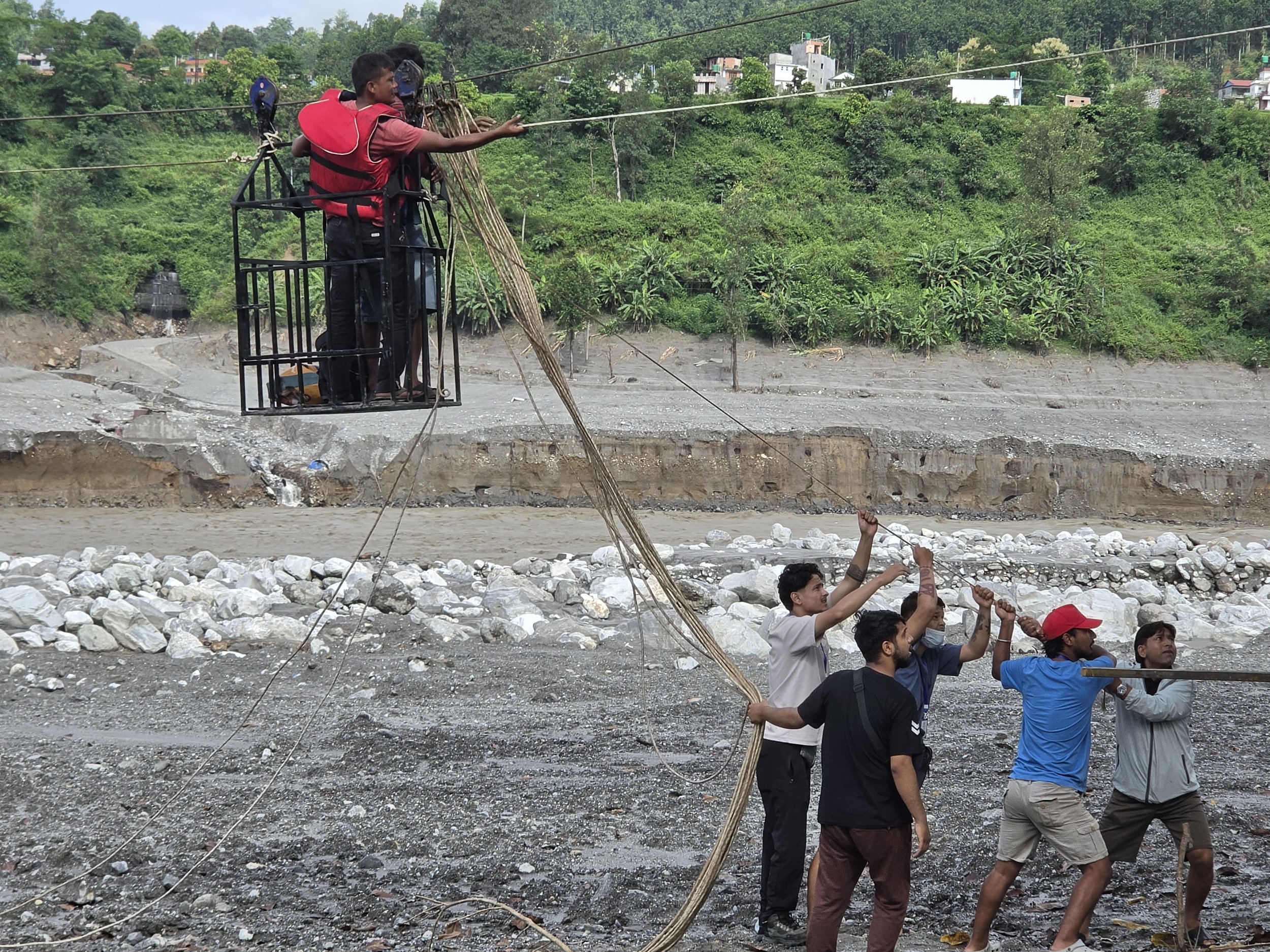
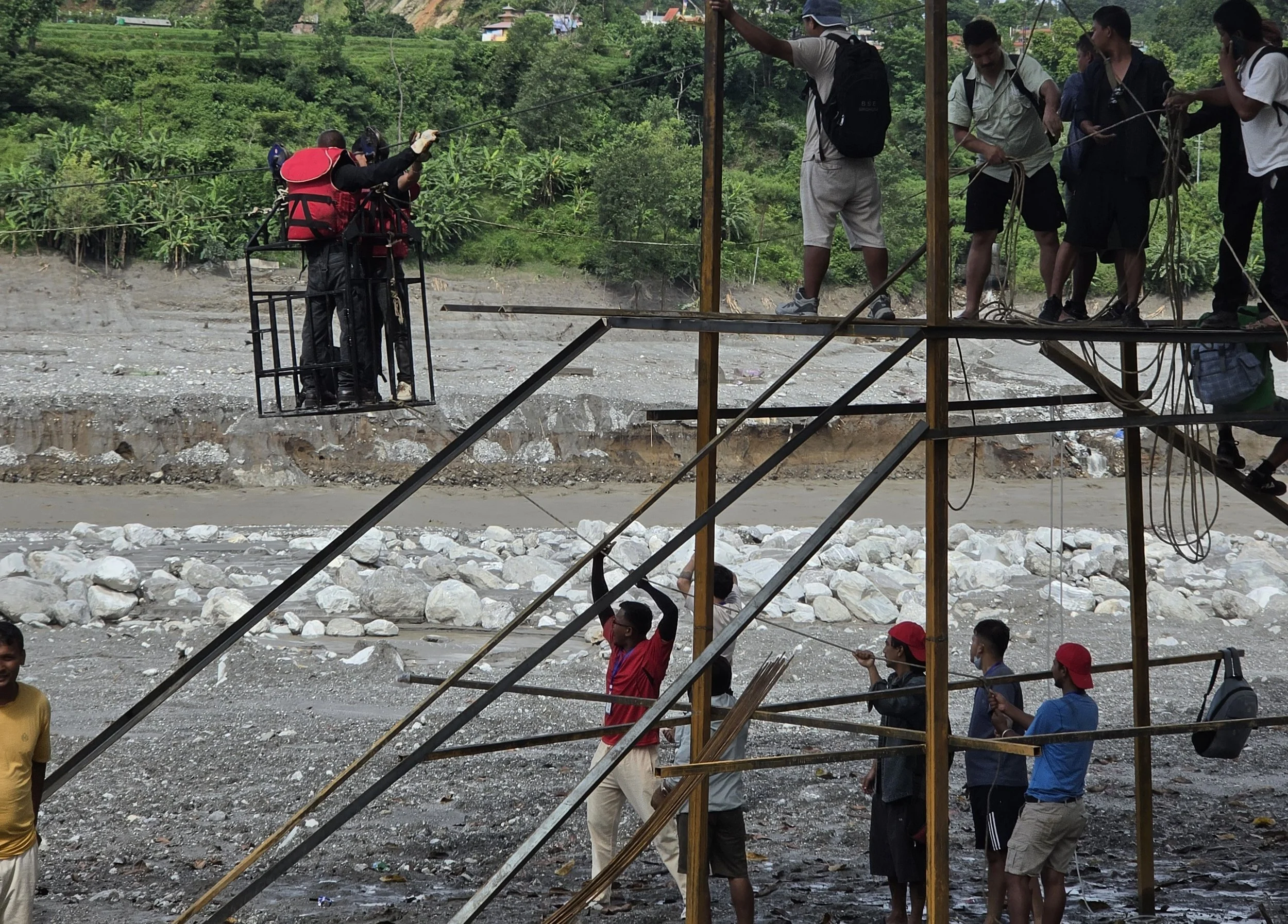
People were building a manual cable crossing. They called it a "Tuin." It was simple, a bucket hanging on a rope, gliding across the roaring river below. Only two people could fit inside at a time. It was dangerous. But it was also beautiful.
We joined them. We pulled the ropes. We held the bucket steady. We helped people climb in, their faces filled with fear and hope mixed together.
And then the bucket moved away.
I watched as it glided across the river, slowly, carefully. On the other side, families were waiting. They waved. They cried. They prayed.
When the bucket reached the other side, the people climbed out. They ran toward their families. Hugs. Tears. Screams of joy.
That was the most beautiful moment for me since day one.
We really helped people cross the river. We helped them go home.
Every time the bucket moved away from the station, carrying two people toward the other side, I felt something in my heart.
Someone is going home today.
It was a small thing. A bucket on a rope. But it was hope. It was everything.
The Children: A Balm for Our Broken Hearts
After the river crossing, we went to the PFA camp near the Kriya Putri Holding Center.
And there, we found the children.
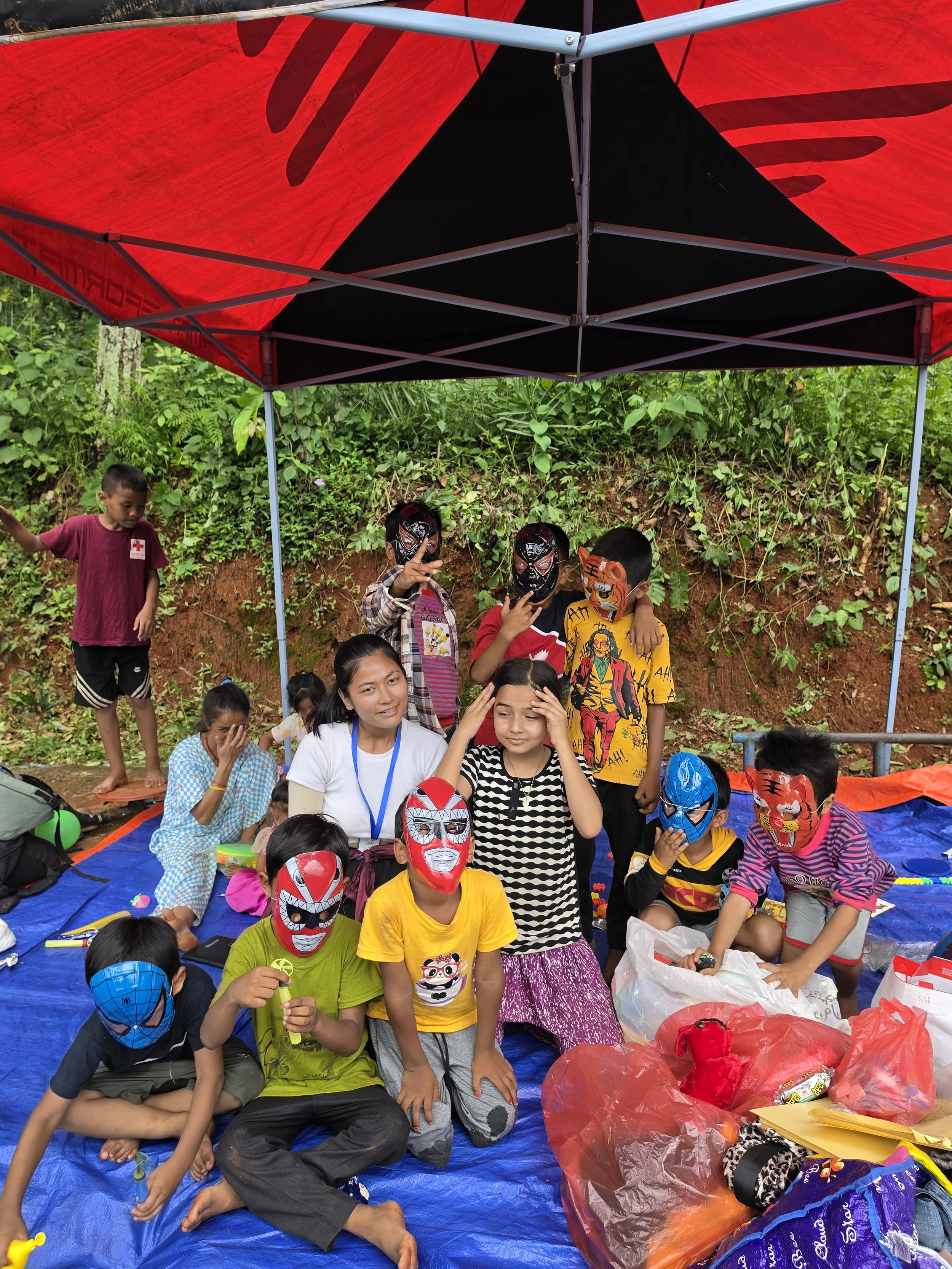
We played with them. We brought recreational materials; crayons, paper, balls. We drew pictures of the sun, flowers and flag of Nepal. We laughed. We ran. We forgot everything just for a little while.
The children were happy. They smiled. They giggled. Their laughter filled the air like music.
And seeing their happiness, I felt more happy than I had in days.
The children were so close to us. They clung to our hands. They sat next to us. They felt safe being around us and that made me feel something I can't explain. Maybe it was purpose. Maybe it was love. Maybe it was just the feeling of being needed.
For a few hours, they forgot they had no home. They forgot they had lost so much. They just smiled.
And their smiles healed us too.
The Badminton Hall Where Stories Broke Us
After midday, me and Ujjwal visited another holding center; the Badminton Covered Hall in Nuwakot.
We walked inside. The place was crowded with families. Children sat in corners, their eyes wide and scared. Mothers held their babies close. Fathers stared at the ground.
We observed the place. We talked with the children.
And they shared their experiences.
One little boy told me he hadn't seen his mother since the flood. A little girl said her father was still missing. Their voices were so small. So fragile.
Some of their mothers were gone. Some of their fathers were gone. They didn't know if they would ever see them again.
We felt so bad for them. So helpless. Our hearts ached with every word they spoke. We wanted to fix everything. But we couldn't. All we could do was listen. All we could do was be there.
And sometimes, that's enough.
After that, we returned to the PFA camp. We helped wrap up the day's activities. We packed the materials. We said goodbye to the children.
September 3, 2026
We woke up early that morning and got ready for the day. The sun was just rising, casting a pale golden light over the hills. But there was no warmth in it. Not for us. Not anymore.
We visited Devighat, another place washed away by the flood. When we arrived, I stood frozen. There was nothing left. Absolutely nothing.
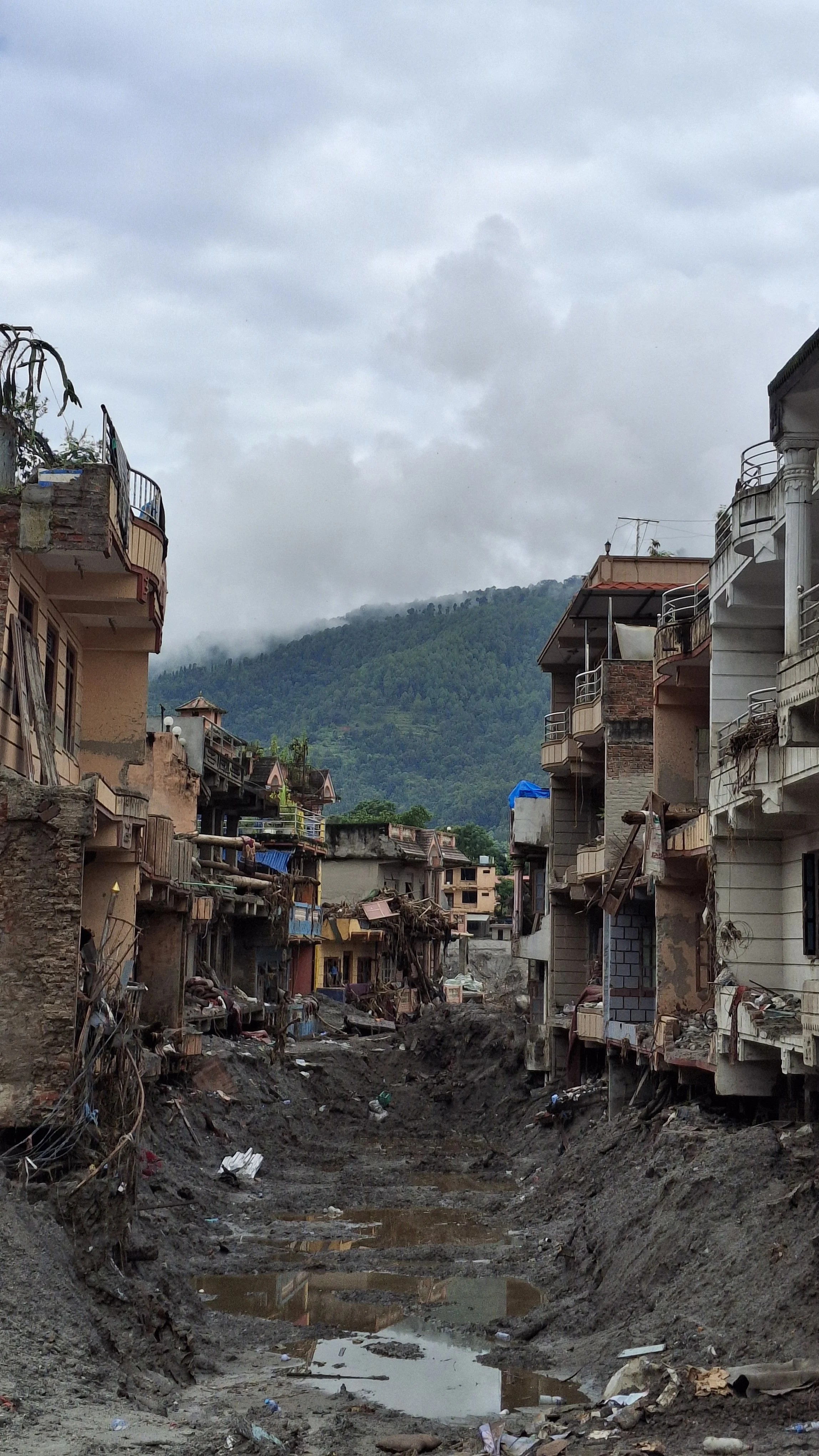
Every house was broken. Every wall had crumbled. Mud covered everything, thick, heavy, suffocating. It was as if the earth itself had opened its mouth and swallowed an entire community.
The river flowed beside the ruins, loud and unapologetic. It roared like a wild animal, proud of what it had done. The sound was deafening. But the silence between the roars was even louder.
I looked around and thought about the different houses. Each one carried different stories.
A home where a child took his first steps. A home where a couple celebrated their wedding. A home where a grandmother told bedtime stories. A home where a family sat together for dinner every night. All of them gone. All of their stories buried.
The Old Men on the Riverbank
And then I saw them.
Two old men were sitting on the bank of the river, the same river that had swallowed the buildings they once called home. They sat in silence, staring at the water. Their backs were bent. Their faces were weathered. Their eyes were distant.
I walked closer. I didn't say anything. I just stood beside them.
One of them looked at me. His eyes were red, but he wasn't crying anymore. Maybe he had no tears left. Maybe he had cried so much that his eyes had gone dry.
"I used to live there," he said, pointing at a pile of mud where a building once stood. "Forty years. Forty years of my life. Gone."
I felt a lump form in my throat. My eyes filled with tears. I couldn't hold them back.
Seeing this view, I felt like someone should never experience this. No one deserves to watch their home, their memories, their lifetime of hard work disappear under a blanket of mud.
All the memories. All the laughter. All the struggles. All the love. All of it now under the mud.
The Holding Centers; Stories of Loss
Then we visited the holding centers at Chandra Jyoti School and Ayurvedic Hospital. Families were crowded together, their faces tired, their eyes hollow.
We talked to the people. We listened to their stories. We felt so bad for them. So helpless. Every story broke us a little more.
After that, our team divided.
Me, Yogesh sir, and Mandira formed one team. Sugam, Bibek, Ujjwal, and Sujan formed another.
Me and Mandira went to a holding center where senior citizens were staying. The room was quiet. The old people sat in corners, their bodies fragile, their minds full of memories.
We sat with them. We talked with them. We listened to their stories.
The Old Man Who Swam in the River
One senior citizen caught my attention. He had kind eyes and a gentle smile. When I sat beside him, he looked at me and his face lit up.
He started telling me about his youth days, back when the world was different. Back when Devighat was alive with laughter and joy.
"I used to play around Devighat," he said, his eyes twinkling. "Me and my friends. We would run through the fields. We would climb the trees. And the river — oh, the river!"
He laughed softly, lost in his memories.
"We used to swim in that river. The water was so clear. So clean. We would jump in and float for hours. We caught fish with our bare hands. We laughed so loud the hills echoed back."
He paused. His smile faded.
"Now look at it. The same river that gave us so much joy — it took everything."
I didn't know what to say. So I just sat with him. I listened. And in that silence, I felt the weight of everything we had lost. Not just houses and roads, but memories. Generations of memories. Gone forever.
But when I left, he was smiling again. Maybe talking about the good days made him feel alive. Or maybe he just needed someone to listen.
The Children; Our Healing
After that, we came back to the PFA camp. We started activities with the children, drawing, playing games, laughing.
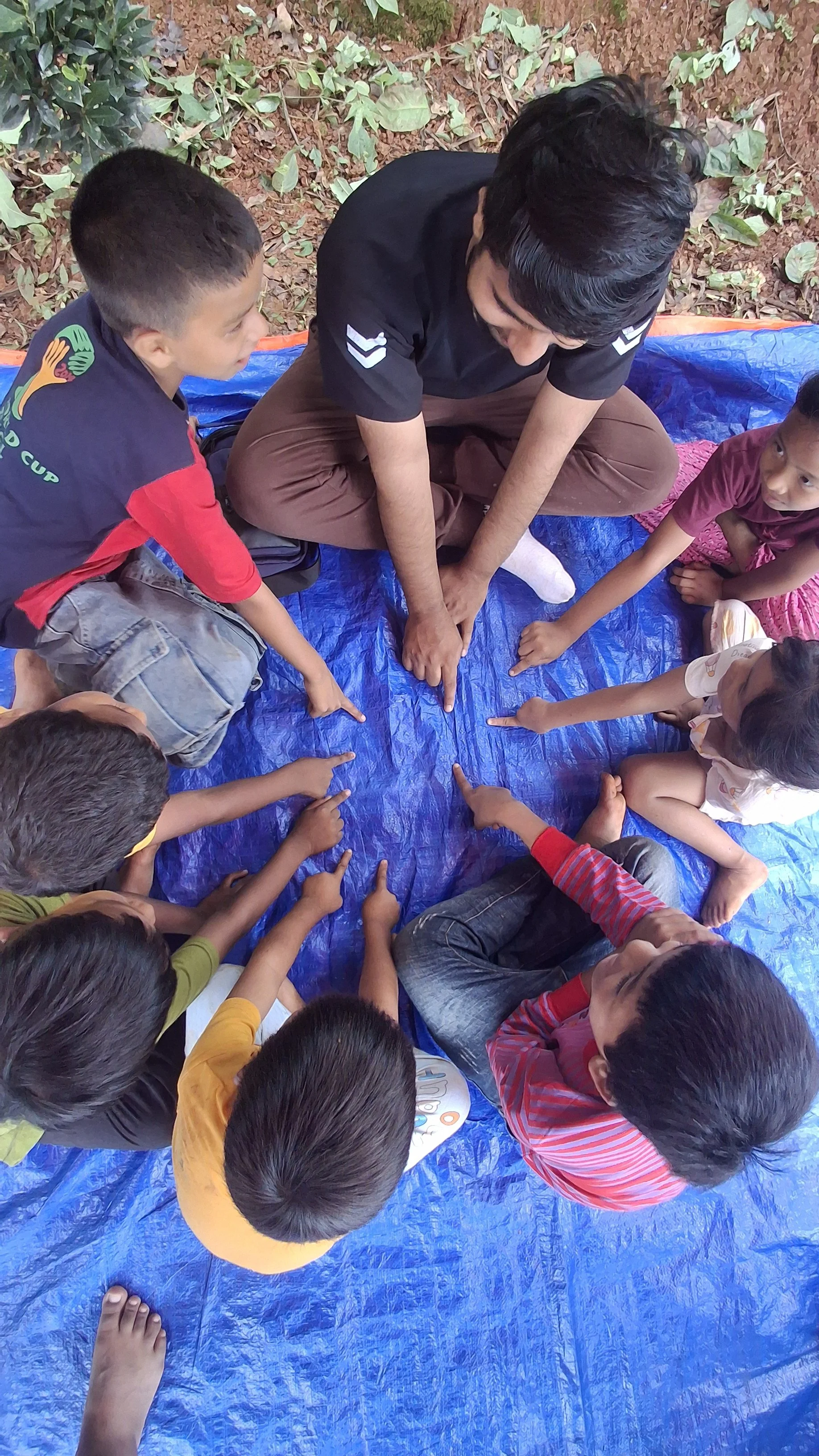
The children were so happy. Their smiles lit up the room. For a few hours, they forgot about the flood. They forgot about their loss. They just smiled.
And seeing their smiles, we smiled too. We played with them. We drew pictures. We ran around like we were children ourselves.
It was our healing. Their joy became our medicine.
After we wrapped up the day's activities, we went back to the hotel. We shared our reflections of the day.
September 4, 2026
It was our last full day in Nuwakot.
We woke up early that morning, the weight of everything we had seen and done pressing down on our hearts. The air felt different. Lighter, somehow. But also heavier because we knew we would have to leave soon.
Sugam had been planning something special. He wanted to personally distribute relief materials to the people who needed them most. So he had coordinated with the Lions Club and his friends from Jhapa. They had collected blankets, clothes, sanitary napkins, toys for children and other essentials. On this day, the materials were finally coming to Nuwakot.
Sugam had worked so hard to make this happen. I could see the determination in his eyes. He wanted to help. He wanted to make a difference.
Listening to the People
Before the materials arrived, we visited different holding centers. We walked through the crowded halls, past families huddled together, past children with hollow eyes.
We asked them a simple question: "What do you need?"
One of them looked at us. An old woman with tired eyes and a face full of wrinkles. Her voice cracked as she spoke.
"I lost everything," she said slowly, her words heavy with pain. "My home. My land. And twenty-five years of property. Everything."
She paused. Her hands trembled.
"What can I ask from you? Do you think I want anything else?"
We stood there, speechless. My heart stopped. Because I realized she had given up. Not just on her belongings. But on hope itself. When someone loses twenty-five years of their life in one day, what can you possibly give them that will make it right?
Nothing. Absolutely nothing.
I wanted to say something, but no words came. We just nodded. We just listened. We let her speak. We let her be heard. Because that's all we could offer.
We continued asking others. Some needed blankets. Some needed clothes. Some needed medicine. Some just needed someone to listen to them.
We wanted to distribute Sugam's relief materials wisely. We wanted to make sure the right things reached the right people. Every item had to count. Every person mattered.
The Arrival and The Chaos
Late afternoon, the truck finally arrived in Nuwakot.
It was carrying hope in the form of bundles of blankets and mattresses, boxes of essential supplies. We rushed to help unload. We were excited. Finally, we could give something back.
We went to different holding centers and started distributing the relief materials. Some places were calm. People waited patiently. They said thank you. They smiled.
But then we reached one holding center.
And everything changed.
The Desperation That Broke My Heart
The moment we arrived, people rushed toward the truck. They climbed onto it. They grabbed at the bags. They pushed each other. They didn't care about order. They didn't care about dignity.
Everyone was climbing the truck to receive the materials.
I stood there, frozen. My heart sank.
Looking at that scene, I felt a strange sadness. A deep, uncomfortable pain. Because I understood what I was seeing.
These were not greedy people. These were not bad people. They were desperate people. They had lost everything, their homes, their belongings, their sense of safety. And now, even though they were ashamed, they were fighting for a blanket and mattress.
Once, they had been wealthy. Once, they had owned homes and businesses. Once, they had dignity and pride. They had never imagined they would end up like this. Scrambling for basics, grabbing at anything they could hold.
Now they were so desperate. So broken.
Watching this, it didn't feel good. It felt terrible. My stomach turned. My eyes burned.
And then I remembered the old man's words.
"What can I ask from you? Do you think I want anything else?"
At that moment, I understood him completely. When you lose everything, your home, your land, your twenty-five years of hard work. What is a bag of rice? What is a blanket? What is anything?
Some losses are so deep that no relief material can ever fill the hole. All we could do was give what we had. All we could do was be present. All we could do was show them that someone cared.
The Unspoken Pain
I wanted to cry. Not because I was sad. But because I understood.
When you lose everything, dignity becomes a luxury you can no longer afford. Survival is all that matters. The need to feed your children, to keep them warm, to give them even a small sense of security, that need overrides everything else.
I watched a woman grab a soft blanket and hold it close to her chest like it was her own child. I watched a man push through the crowd, his face filled with desperation. I watched children cling to their parents, not understanding why everyone was so frantic.
And I thought to myself: This is what disaster does. It strips people of everything, not just their homes, but their dignity. Their pride. Their sense of who they are.
The Lesson I Will Never Forget
That night, after we finished distributing the materials, we returned to the hotel.
We sat together in silence.
We had seen so much in the past few days. We had seen death. We had seen tears. We had seen children smile and laugh. We had seen families reunited.
But this was different. This was the raw, ugly face of desperation. This was what happens when people are pushed to their limits.
And it taught me something I will never forget:
Disasters don't just destroy buildings. They destroy people. They take away everything. Homes, memories, dignity, hope. And when you see someone who was once wealthy fighting over basic essentials, you realize that none of us are safe. None of us are immune.
We are all just one disaster away from losing everything.
A Final Thought
That night, I lay in bed, staring at the ceiling. The ceiling fan spun above me and for the first time, it didn't sound like a helicopter.
Maybe my heart was finally healing. Or maybe I was just too tired to be scared anymore.
I thought about the people we had helped. The woman who smiled when she heard her son's voice. The little girl who held my hand. The old man who swam in the river. The old women who had lost twenty-five years of her life and had nothing left to ask for.
And the desperate faces of people climbing onto a truck for a blanket and mattress.
They were all part of the same story. The story of loss. The story of survival. The story of hope.
And I knew no matter how hard it was to watch, I was grateful to have been there. Grateful to have seen the truth. Grateful to have helped, even in the smallest way.
This was our last day. But the stories would stay with me forever.
September 5, 2026
Early in the morning, we packed our bags and got our bikes ready. We were preparing to head back to Kathmandu.
We thanked all the team members and everyone who had helped us. Yogesh sir, Pawan sir, and Mandira were still serving in Nuwakot. They were staying behind to continue the work, the work that had no end, the work that would take months, maybe years.
Only me, Ujjwal, Sugam, and Bibek had to return to Kathmandu. Our final exams were waiting for us. Sujan also returned due to his personal work in Kathmandu.
But I wasn't returning empty-handed. I was returning with the stories of Nuwakot. Heavy stories. Beautiful stories. Stories that would stay with me forever.
After breakfast, we got on our bikes. As we started our engines, I looked back at the valley one last time.
The Weight of What I Saw
Being deployed to Nuwakot was a lifetime experience for someone as ordinary as us. We were just a student. Just a volunteer. Just someone who wanted to help.
But when you work with human stories and emotions and when you believe in being on the ground, you begin to understand something very different. Something you can never learn from books. Something no classroom can teach.
No matter how many hundreds or thousands of photographs, videos, or human stories you collect, it will never be enough. It will never be enough to showcase the full reality of a disaster like this.
There is no camera in the world that can capture the whole aftermath of the Nepal floods.
You can show a collapsed house. But you can't show the family who built it with their sweat and dreams. You can show a crying face. But you can't show the years of love behind those tears. You can show a statistic. But you can't show the life behind each number.
The Numbers That Are Not Just Numbers
Thousands of lives lost. People still missing. Livelihoods destroyed. Homes buried under mud. Water and sanitation systems damaged beyond repair. More than forty-two kilometers of roads affected along with bridges damaged or simply washed away.
These are numbers. But they are not just numbers.
Every number is a father. A mother. A child. A dream. A hope. A lifetime of memories. And now, they are just numbers in a headline.
And then there is another reality.
Media framing. The hidden meaning behind headlines. The way numbers sometimes become more important than people's lives. The way a story loses its humanity when it becomes news.
I saw it with my own eyes. I felt it in my own heart.
A Warning We Cannot Ignore
This Himalayan tsunami is not just a disaster. It is also a painful reminder of the consequences of a changing climate, whether we choose to acknowledge our collective accountability for it or not.
It showed us that global warming is not propaganda. It is not a political issue. It is not something that belongs to any specific community.
It is real. It is here. And it is destroying lives.
Yet the discussion around climate accountability, humanitarian diplomacy, and climate loss and damage still feels far too small compared to the scale of what is happening. Big words. Big meetings. But for the people of Nuwakot, those words don't fill empty stomachs. They don't bring back fathers. They don't rebuild schools. They don't bring back twenty-five years of property lost in one day.
The Uncertainty of Tomorrow
Thousands of people here still don't know what comes next.
And honestly, I don't know either.
What I saw on the ground was something I had never witnessed before. The scale of destruction is difficult to comprehend. It is beyond imagination. Beyond words.
I don't know what Nepal will look like one or two years from now. I don't know how long it will take for these communities to rebuild their homes, their livelihoods, and their lives.
And some things may never return to what they were.
Maybe that is the hardest part of all. The knowing that some losses are permanent. Some wounds never fully heal. Some stories have no happy ending.
The Stories I Carry
But I am leaving with so many stories in my heart. Stories of loss. Resilience. Love. Hospitality. Courage. Humanity.
Stories I haven't put into selected folders yet. Stories I haven't turned into ready-to-use content. Stories that don't have a caption or a proper frame.
And perhaps some stories don't need to be immediately edited, packaged, or published. Some stories just stay with you. They live inside you. They become a part of who you are.
I am leaving with so much gratitude. So many experiences. So much learning.
And a lot of stories that I will probably carry with me for a very, very long time.
The Unbreakable Spirit
I believe these people will come back.
They will rebuild. They will rise. They will fight.
Because giving up is not in their blood. Not in their blood at all.
I saw it with my own eyes. A woman who smiled after hearing her son's voice. A child who laughed while drawing a flag. An old man who found peace in sharing his memories. A community that refused to let go of hope.
This is the spirit of Nepal. You cannot kill it. You cannot drown it. You cannot bury it under mud.
It is fire. It is life. It is everything.
And I am so grateful to have witnessed it.
A Final Reflection
As I rode back to Kathmandu, the wind in my face, the hills passing by, I thought about everything I had seen and done.
The smell of death. The sound of helicopters. The desperate faces. The tears. The smiles. The children's laughter. The old man's memories. The Tuin crossing. The chaos of relief distribution.
All of it. Every single moment.
I had gone to Nuwakot to help. But in the end, Nuwakot helped me. It taught me about loss. It taught me about love. It taught me about the strength of the human spirit when everything else is gone.
It taught me that no matter how bad things get, hope is always there. Sometimes hidden. Sometimes buried under mud. But always there.
And that is what I will carry with me.
That is the story I will tell.
That is the lesson I will never forget.
-------------------------------------------------------------------------------------------------------------------------------
This is for the people of Nuwakot. For their loss. For their resilience. For their love. For their courage. For their hope.
May their stories never be forgotten. May their spirit never be broken.
-Roshan
Public Health Worker and PFA Volunteer
Roshan Shrestha is a public health worker, PFA (Psychosocial First Aid) volunteer, and an MSW candidate at Kadambari Memorial College. He has dedicated himself to serving communities in times of crisis. His journey as a volunteer began during the Nepal Earthquake in 2015, continued through the COVID-19 pandemic, and most recently led him to the frontlines of the Bhotekoshi Flash Flood in 2026. Roshan believes in the power of being on the ground, listening to human stories, and showing up when it matters most.
About Youth Initiative:
Youth Initiative (YI) is a youth-led organization dedicated to the capacity development and empowerment of young people in Nepal. Established in 1999 and formally registered in 2001, YI envisions a society where young people are involved, valued, respected, and listened to—a society where they feel safe and can develop to their fullest potential.
As one of Nepal's leading youth organizations, YI works to promote youth empowerment, strengthen student and youth politics, and advance civic engagement, democratization, and human rights. The organization believes that investing in youth today contributes to the holistic development of individuals and society at both the present and future levels.
Through training programs, workshops, youth camps, and mental health initiatives, YI continues to create platforms for young people to raise their voices, share their stories, and become agents of positive change in their communities.


